

The key difference: where the energy is delivered
Ultherapy and Endolift both aim to tighten loose skin without surgery, and both work by heating tissue so that it contracts and produces new collagen over the following months. The main difference is where the energy goes in.
Ultherapy is a focused ultrasound treatment. A handpiece is moved over the surface of the skin, and the energy passes through the skin to heat tissue at set depths underneath. Nothing goes under the skin. Endolift is minimally invasive. A very fine laser fibre is placed beneath the skin through a tiny entry point, so the energy is delivered directly into the layer being treated.
That single difference shapes most of the rest of the comparison: what each can do with fat, what the recovery looks like, and who tends to suit each. Ultherapy belongs to the wider group of focused ultrasound treatments often called HIFU, compared in more detail on the Endolift vs HIFU page.
How Endolift works
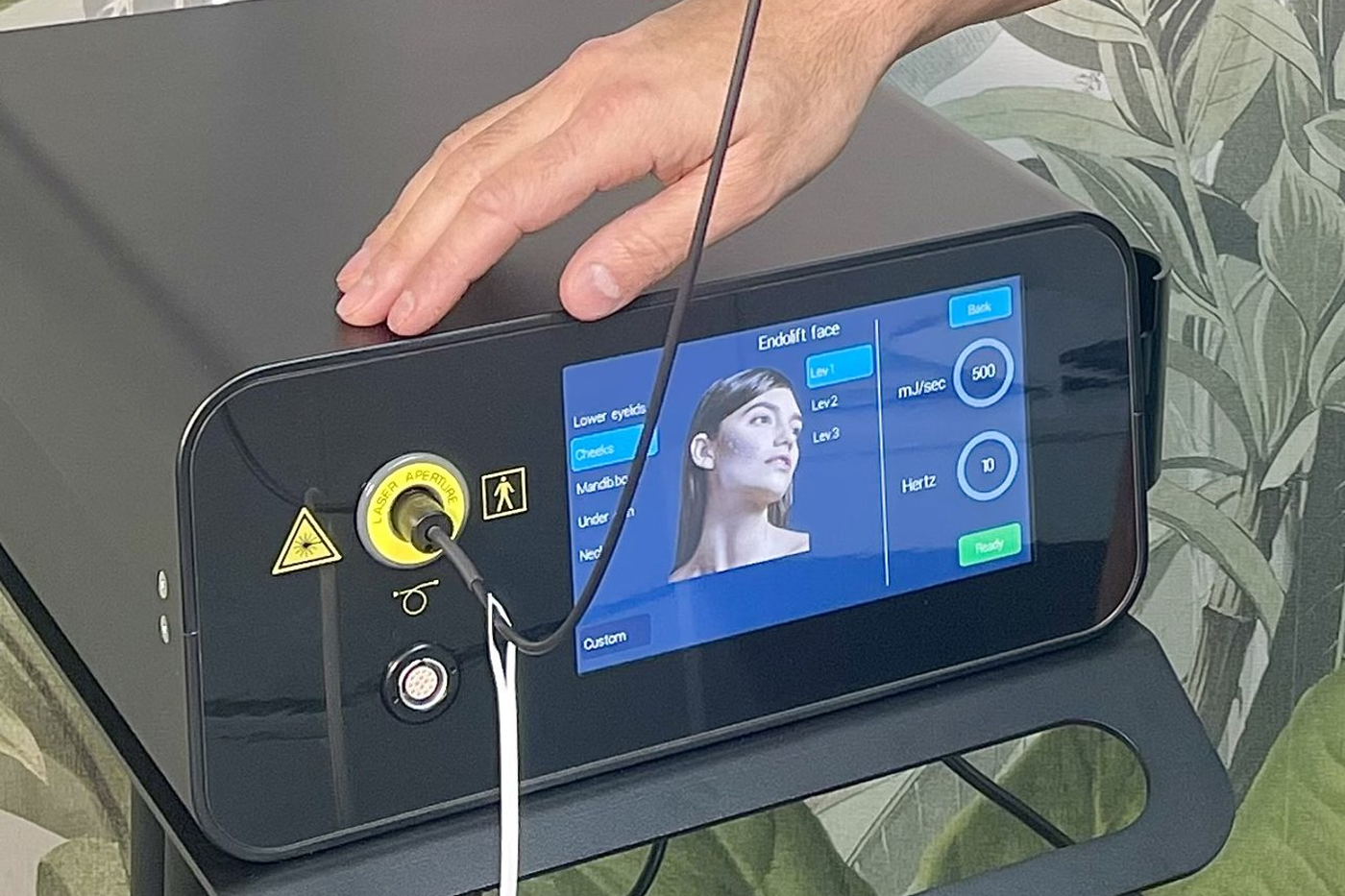
Genuine Endolift uses the LASEmaR 1500 laser by Eufoton at a wavelength of 1470 nm, with original single use fibres. The fibre is between 200 and 600 microns wide, about the thickness of a hair, and is placed under local anaesthetic with no incisions and no stitches.
The 1470 nm wavelength is strongly absorbed by water and fat. It contracts the fibrous septa beneath the skin, which gives some tightening straight away. It can liquefy small fat deposits, which the body then clears. And it triggers collagen remodelling, in which weaker Type III collagen is replaced by stronger Type I, so results usually improve for around 6 months. A session takes about 60 to 90 minutes, and most people need 1 session. The genuine Endolift page explains the system in more detail.
Side by side
| Question | Endolift | Ultherapy |
|---|---|---|
| Energy | Laser at 1470 nm | Focused ultrasound |
| Delivered | Beneath the skin through a tiny entry point | Through the surface of the skin |
| Small fat pockets | Can liquefy small deposits | Ask the clinic what to expect |
| Anaesthetic | Local anaesthetic | Ask the clinic; it varies |
| Expected aftereffects | Swelling, bruising, tenderness, temporary numbness | Ask the clinic for the usual course |
| Heavy, hanging skin | Not suitable; surgery is better | Not suitable; surgery is better |
If you are considering Ultherapy, ask the clinic to explain how many sessions it expects you to need, what the treatment feels like, what side effects are usual, and what the total price will be for your areas. Those answers vary between clinics and between faces, so they are worth getting in writing.
The same applies to Endolift. A clinic should tell you who will perform the treatment, what is included in the price, and what recovery to plan for. At TK Medispa, a written consultation summary and consent form are sent to you before treatment day so you can read them at home, and if you decide on the day not to go ahead, you receive a full refund. The patient journey page sets out each step.
Who tends to suit each approach
Neither treatment is right for everyone, and the choice depends on your face more than on the device. As a general guide:
- Small fat pockets under the chin or along the jaw, with mild to moderate loose skin: Endolift is often the better fit, because it treats fat as well as skin.
- Mild laxity with very little fat, and a strong wish to avoid any entry point: a surface treatment such as Ultherapy may be worth discussing.
- Lost volume or hollowing: neither treatment restores volume, so another approach may be needed.
- Heavy, hanging skin or marked jowls: surgery usually gives a clearer result. A London facelift typically costs £7,000 or more.
Recovery and risks with Endolift
Because Endolift works beneath the skin, it has a more noticeable short recovery than many surface treatments. Expect swelling, bruising, redness and tenderness, with temporary numbness and some firmness or lumps where fat was treated. Most of this settles within days, though numbness and firmness can take 1 to 2 weeks or longer. A compression strap is worn on the neck for 3 to 4 days. Most people return to work the next day or within 48 hours.
Rarer risks include burns, skin irregularity, infection, scarring at the entry points and temporary nerve weakness, for example of the marginal mandibular nerve, which can affect the smile for a period. The side effects and safety page explains each plainly. Results can last up to 2 years, depending on age, skin, weight stability, sun exposure and smoking. Results vary.
Cost at TK Medispa
At TK Medispa in Kensington, Endolift costs £1,500 for a single face area, £2,000 for the lower face and £2,500 for the full face. Each price includes the photo assessment, video consultation, treatment, local anaesthetic, aftercare and review. Genuine Endolift in London generally ranges from roughly £1,450 to £4,900, depending on the clinic and the areas. The cost page lists every area.
Dr Seth's view "When a patient is choosing between a surface treatment and Endolift, I ask what is actually there under the skin. If there is a small amount of fat as well as looseness, I think it makes sense to treat it directly from beneath. If the patient wants to avoid any swelling at all, I explain that honestly, because Endolift does involve a few days of recovery."
Next step
To find out whether Endolift suits your face, send 3 photos (front, left and right, in natural light) for Dr Seth's free assessment through the booking page.
Questions people also ask
Is Ultherapy the same as HIFU?
Ultherapy is a focused ultrasound treatment, and focused ultrasound treatments are often grouped under the name HIFU. Devices and settings differ, so ask the clinic which device it uses. The Endolift vs HIFU page compares surface ultrasound with Endolift in more detail.
Why does Endolift cause more swelling than surface treatments?
Endolift places a fibre under the skin and can liquefy small fat deposits, so the tissue reacts more in the first days. Swelling, bruising and tenderness are expected and usually settle within days. Most people return to work the next day or within 48 hours.
Can I have Endolift if Ultherapy did not work for me?
Sometimes. It depends on why the first treatment did not meet your expectations. If there was fat as well as loose skin, or if the laxity is mild to moderate, Endolift may help. If the skin is heavy, surgery may be the more honest option. Mention your previous treatment when you send photos.
Which lasts longer, Endolift or Ultherapy?
Endolift results can last up to 2 years, depending on age, skin, weight stability, sun exposure and smoking. For Ultherapy, ask the clinic what it expects for your face. With either treatment, results vary and ageing continues.
This article is general information, not personal medical advice. Results vary between individuals and are not guaranteed. Endolift® and LASEmaR® are registered trademarks of Eufoton® S.r.l.