

Heating tissue from the inside: 2 approaches
Endolift and FaceTite belong to the same broad family. Both place a source of energy under the skin rather than on top of it, and both aim to tighten skin and reduce small pockets of fat without the scars of a facelift. The difference lies in the type of energy.
Endolift uses laser light. FaceTite uses radiofrequency. Each heats the tissue in a controlled way, and that heat leads to contraction of the supporting tissue and, over the following months, new collagen. Patients often ask which is stronger. A more useful question is which suits their face, and who will be performing it.
Both treatments sit between skin treatments applied from the surface, such as ultrasound or microneedling with radiofrequency, and surgery. They reach deeper than surface treatments because the energy is delivered directly beneath the skin. They do not remove skin or reposition the deeper tissues the way a facelift does. Understanding that middle position helps set fair expectations for either option.
How Endolift works
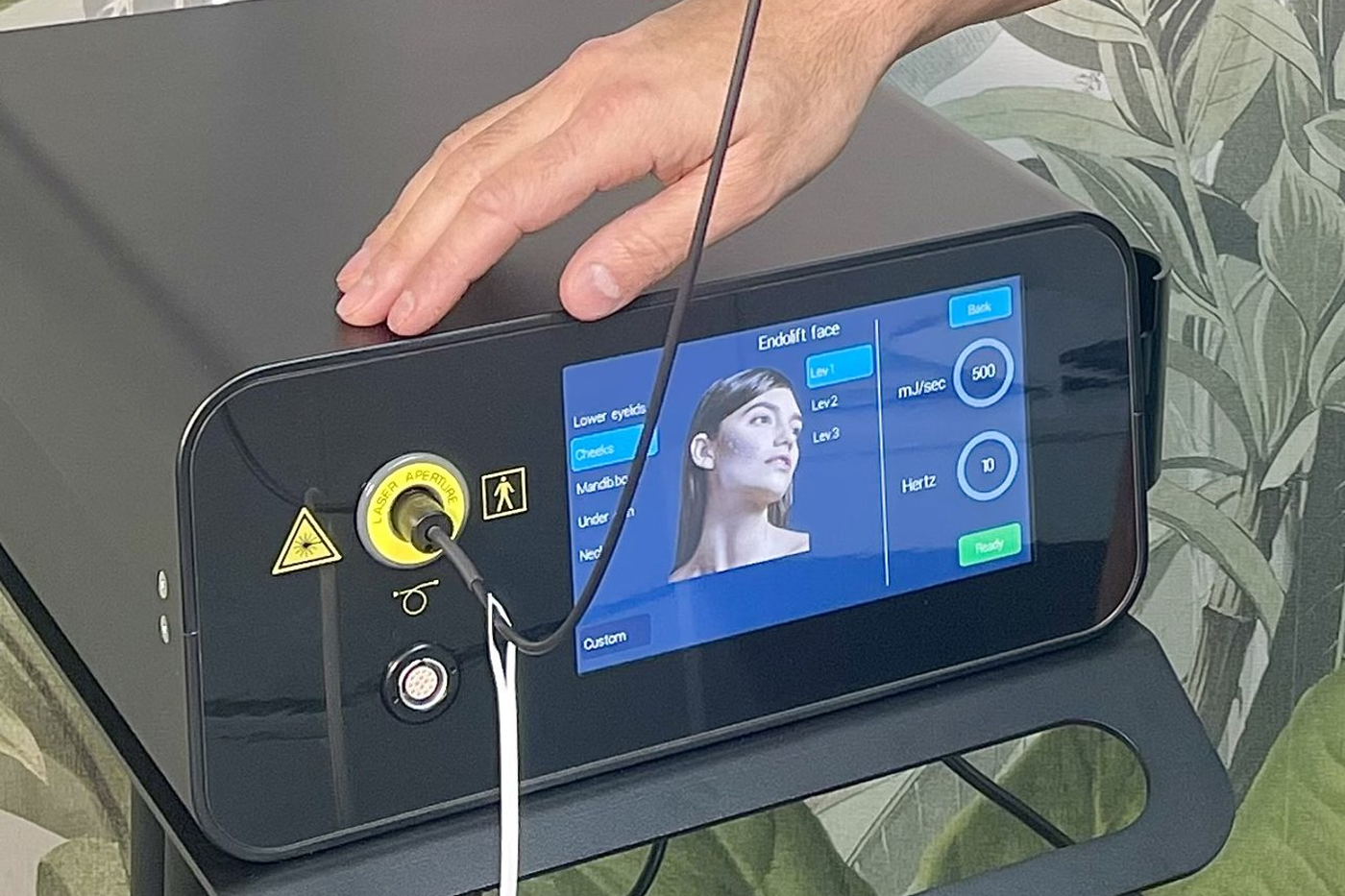
Genuine Endolift uses the LASEmaR 1500 laser by Eufoton at a wavelength of 1470 nm, with original single use fibres. The fibre is between 200 and 600 microns wide, roughly the thickness of a hair. It is placed beneath the skin through a tiny entry point under local anaesthetic, with no incisions and no stitches.
The 1470 nm wavelength is strongly absorbed by water and fat. That has 3 effects. It contracts the fibrous septa, the bands that connect skin to deeper tissue, which gives some immediate tightening. It can liquefy small fat deposits. And it triggers collagen remodelling, as weaker Type III collagen is replaced by stronger Type I. The result usually continues to improve for around 6 months. More detail is on the page about genuine Endolift.
How FaceTite works, in general terms
FaceTite is a radiofrequency assisted treatment. Rather than laser light, it uses radiofrequency energy delivered under the skin to heat and tighten the tissue. Like Endolift, it is used for loose skin and small fat pockets on the lower face and neck, and like Endolift it is not a substitute for a facelift when skin is heavy and hanging.
The details of a FaceTite treatment, including the type of anaesthetic, the number of entry points and the recovery, vary between clinics. If you are considering FaceTite, ask the clinic to explain each of these for your own face, along with the specific risks. It is also reasonable to ask how many treatments the clinician has performed, and to see before and after photos of their own patients taken in consistent light. The same questions apply to Endolift, and the before and after page shows what such photos should look like.
Side by side
| Question | Endolift | FaceTite |
|---|---|---|
| Energy used | Laser at 1470 nm | Radiofrequency |
| Best suited to | Mild to moderate laxity and small fat pockets | Mild to moderate laxity and small fat pockets |
| Anaesthetic | Local anaesthetic | Ask the clinic; it varies |
| Typical London price | Roughly £1,450 to £4,900 depending on clinic and areas | Typically £5,000 to £6,000 |
| Not suitable for | Heavy, hanging skin or lost volume | Heavy, hanging skin or lost volume |
Neither treatment restores lost volume. If your face has hollowed with age or weight loss, you may need a different approach as well as, or instead of, tightening. If your skin hangs in folds, surgery is the more honest answer. The Endolift vs facelift page explains where that line usually falls.
Recovery and risks with Endolift
A face or neck treatment with Endolift takes about 60 to 90 minutes, usually in 1 session. Afterwards, swelling, bruising, redness and tenderness are expected, along with temporary numbness and some firmness or lumps where fat was treated. Most of this settles within days. Numbness and firmness can take 1 to 2 weeks or longer. A compression strap is worn on the neck for 3 to 4 days, and most people return to work the next day or within 48 hours.
Rarer risks include burns, skin irregularity, infection, scarring at entry points and temporary nerve weakness. Along the jaw, irritation of the marginal mandibular nerve can affect the smile for a period. Any treatment that heats tissue under the skin carries some risks of this kind, so ask any clinic, whichever device it uses, to talk you through them. The side effects and safety page covers Endolift in more depth.
Results can last up to 2 years, depending on age, skin, weight stability, sun exposure and smoking. Results vary.
Cost and how to choose
At TK Medispa in Kensington, Endolift costs £1,500 for a single face area, £2,000 for the lower face and £2,500 for the full face. Each price includes the photo assessment, video consultation, treatment, local anaesthetic, aftercare and review. The cost page lists every area. FaceTite in London is typically £5,000 to £6,000, so price is often part of the decision.
Price should not be the only factor. These questions matter just as much:
- Is my laxity mild to moderate, or would surgery serve me better?
- Who performs the treatment, and how many have they done?
- What anaesthetic is used, and what recovery should I plan for?
- What does the price include, and is there a review with after photos?
Dr Seth's view "In my experience the device matters less than the selection of the patient and the care taken during treatment. Both approaches can tighten mild to moderate laxity. I use Endolift because it works well under local anaesthetic and suits the faces I see most. For heavy, hanging skin I recommend surgery, whichever device a patient is considering."
Next step
If you are weighing up Endolift against FaceTite, send 3 photos (front, left and right, in natural light) for Dr Seth's free assessment through the booking page. He will give you a frank view of whether Endolift suits you.
Questions people also ask
Is Endolift or FaceTite better for a double chin?
Both can help small fat pockets under the chin with mild to moderate loose skin. Neither is meant for large volumes of fat or heavy skin. Which suits you depends on your anatomy and the clinician's experience, so an assessment of your own neck is more useful than a general ranking.
Why is FaceTite usually more expensive than Endolift?
Prices vary between clinics and reflect the device, the setting, the anaesthetic and who performs the treatment. In London, FaceTite is typically quoted at £5,000 to £6,000, while genuine Endolift ranges from roughly £1,450 to £4,900 depending on the clinic and areas.
Can I have Endolift if I have already had FaceTite?
It may be possible, but it needs careful assessment. Dr Seth would want to know when the previous treatment was done, which areas were treated and how your skin responded. Mention any earlier treatments, including fillers or threads, when you send your photos.
Do either of these replace a facelift?
Not for everyone. Both can give a worthwhile change in mild to moderate laxity. When skin hangs or jowls are heavy, a surgical facelift removes and repositions tissue in a way that tightening from beneath the skin cannot match. A London facelift usually costs £7,000 or more.
This article is general information, not personal medical advice. Results vary between individuals and are not guaranteed. Endolift® and LASEmaR® are registered trademarks of Eufoton® S.r.l.