


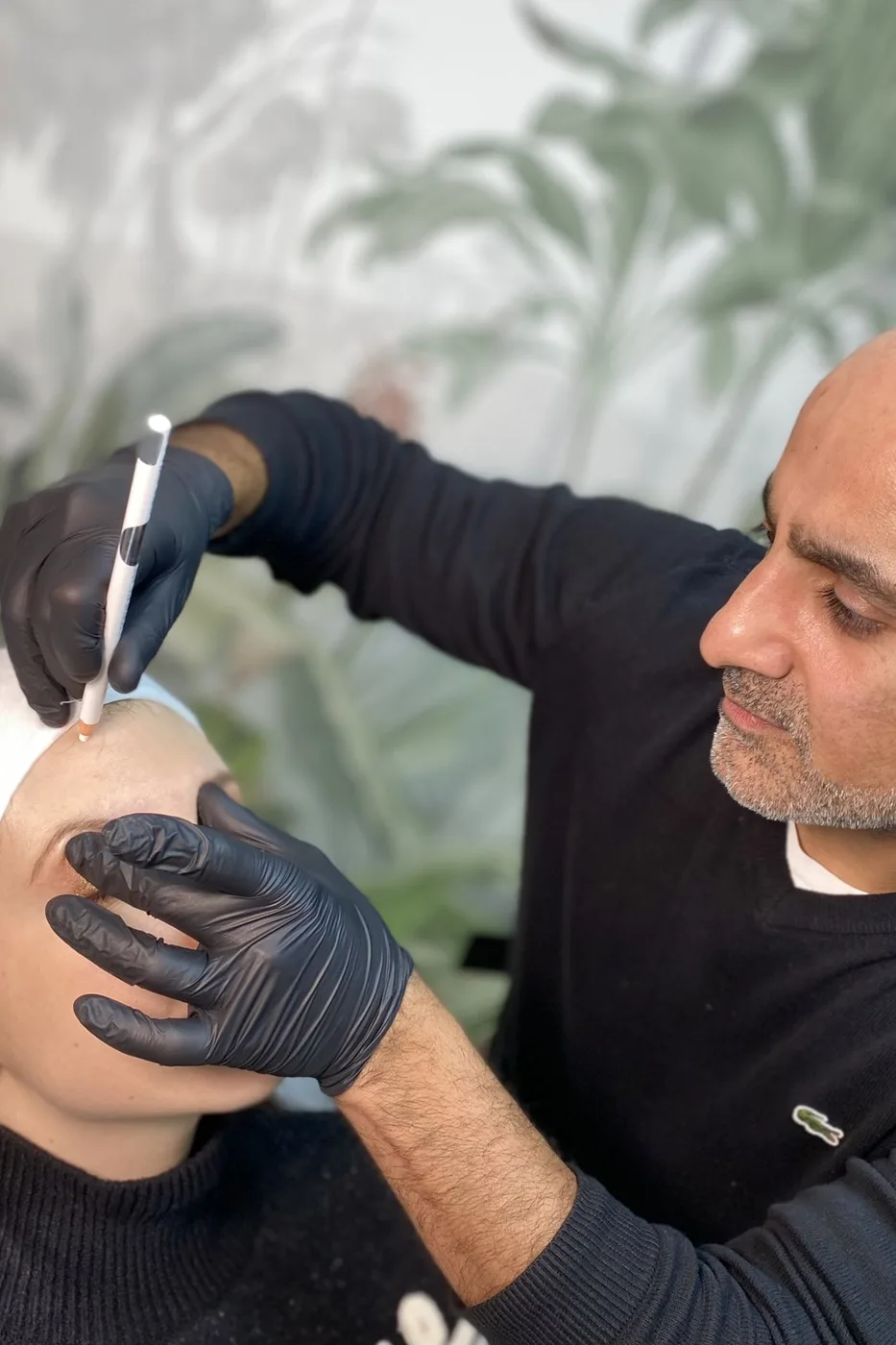
Safety is the right first question to ask about any treatment, and it deserves a straight answer rather than reassurance. Endolift is a minimally invasive laser treatment, not surgery, and for most people the experience is uneventful. That does not mean it is free of risk. Every treatment that passes energy beneath the skin can cause harm if it is used on the wrong person, with the wrong settings, or by someone who does not understand the anatomy underneath. This article explains what happens during the treatment, what is normal afterwards, what the rarer complications are, and what you can do to reduce your chances of a problem.
What Endolift actually does beneath the skin
Genuine Endolift uses the LASEmaR 1500 laser made by Eufoton, at a wavelength of 1470 nm. A very thin fibre, between 200 and 600 microns wide, is passed beneath the skin through a tiny entry point after local anaesthetic has been given. There are no incisions and no stitches.
Light at 1470 nm is strongly absorbed by water and fat. That gives 3 effects. The fibrous bands under the skin, called septa, contract, which gives some immediate tightening. Small pockets of fat can be liquefied. Over the following months the body remodels its collagen, replacing weaker Type III collagen with stronger Type I collagen, which is why results continue to develop for around 6 months.
The safety of the treatment depends on keeping that heat in the right layer, at the right dose, for the right length of time. Most of the rarer complications described below come from heat going where it should not, or staying too long in a single spot.
Normal side effects you should expect
These are not complications. They are the body's usual response to the treatment, and almost everyone has some of them.
- Swelling, which is usually most noticeable in the first few days.
- Bruising, which varies a great deal from person to person.
- Redness over the treated area.
- Tenderness when you touch or move the area.
- Temporary numbness, which can take 1 to 2 weeks or longer to fade.
- Temporary firmness or small lumps where fat was treated, which also settle over 1 to 2 weeks or longer.
Most of these settle within days. Most people return to work the next day or within 48 hours, although that varies. For neck and body areas a compression garment or strap is worn for 3 to 4 days to help the tissues settle. There is a fuller guide to which side effects are normal and which are not if you want more detail.
The rarer risks, explained plainly
These are uncommon, but you should know about them before you agree to treatment. A good clinic will discuss each of them with you and write them on your consent form.
| Risk | What it means | What usually happens |
|---|---|---|
| Burns | Too much heat reaches the skin surface from beneath. | Needs prompt assessment and wound care; may leave a mark. |
| Skin irregularity | Uneven contour or dimpling where tissue tightened unevenly or fat was removed unevenly. | Often improves as swelling settles; occasionally needs further treatment. |
| Temporary nerve weakness | Heat or swelling affects a small nerve, for example the marginal mandibular nerve along the jaw, which can make the smile look uneven. | Usually recovers over weeks to months. |
| Infection | Bacteria enter through an entry point. | Treated with antibiotics; rare when the procedure is done in clean conditions. |
| Scarring at entry points | The tiny entry marks heal as small visible marks. | Usually very small; more likely in people who form keloid scars. |
Nerve weakness is the risk that worries patients most, so it is worth explaining. Along the lower jaw runs a small branch of the facial nerve that controls the lower lip. If it is irritated, the smile can look lopsided for a while. This is why the person treating you needs to know exactly where that nerve runs and how to keep the fibre and the heat away from it.
Who should not have Endolift
Part of safety is not treating people who are unlikely to benefit or who have a higher chance of a problem. Endolift is not suitable during pregnancy or breastfeeding, or when there is an active infection in the area. It needs careful discussion if you have some blood clotting conditions, an autoimmune condition, a history of keloid scarring, or recent fillers or threads in the area to be treated.
It is also not the right tool for heavy, hanging skin, where surgery usually gives a better result, and it is not a weight loss treatment. Treating someone whose problem Endolift cannot fix is not dangerous in the usual sense, but it is a poor outcome. Our guide on who should not have Endolift covers this in more depth.
How to lower your risk
You cannot remove risk entirely, but you can reduce it a great deal by choosing carefully.
- Check the device is genuine. Ask whether it is the Eufoton LASEmaR 1500 with original single use fibres. Unbranded copy devices advertised from around £700 to £1,000 may not have the same controls. There is more on this at how to tell genuine Endolift.
- Check who is treating you. A doctor with surgical training understands the layers of the face and where the nerves run. Ask for their GMC number and check it.
- Be honest in your medical history. Mention medicines that affect bleeding, autoimmune conditions, previous fillers or threads, and any tendency to scar badly.
- Follow the aftercare. Wear the compression garment if advised, keep the entry points clean and report anything unusual early.
- Make sure there is a follow up plan. You should know who to contact if something worries you, and you should have a review booked.
Dr Seth's view "Most of the problems I am asked to look at did not come from the laser itself. They came from treating the wrong person, or from someone who did not know the anatomy well enough to keep the heat away from a nerve. Choosing the right patient and treating conservatively matters more than any single setting on the machine."
How Endolift compares with surgery for safety
A surgical facelift involves a general anaesthetic or deep sedation, longer incisions and a longer recovery, and it carries its own set of risks. Endolift avoids incisions and is done under local anaesthetic, which is a large part of its appeal. But the 2 treatments do different jobs. Surgery can remove and lift heavy excess skin, which Endolift cannot. A fair comparison looks at what each treatment can achieve for your particular face, not only which is less invasive. You can read more at Endolift compared with a facelift.
Next step
If you would like a personal view on whether Endolift is suitable and safe for you, you can send 3 photos (front, left and right, in natural light) for Dr Seth's free assessment. He will tell you honestly if it is not the right treatment. Send your photos here.
Questions people also ask
Can Endolift cause lasting nerve damage?
Temporary nerve weakness is a recognised but uncommon risk, most often affecting the marginal mandibular nerve along the jaw, which can make the smile look uneven. In most reported cases it recovers over weeks to months. Careful technique by someone who knows where the nerves run is the main way to reduce this risk.
Is Endolift safer than a surgical facelift?
Endolift avoids incisions and general anaesthetic, so the recovery is usually shorter and some surgical risks do not apply. It still has its own risks, such as burns and nerve weakness. The 2 treatments also suit different problems, so the safer choice depends on what your skin needs.
Are cheaper Endolaser devices less safe?
Not every cheaper device is unsafe, but unbranded copies may not offer the same precision, fibres or safety controls as the genuine Eufoton LASEmaR 1500. You also have less information about how they were tested. Ask the clinic exactly which device and fibres they use before you book.
What should I do if something feels wrong after treatment?
Contact the clinic that treated you promptly, ideally with photos. Increasing pain, spreading redness, heat, discharge from an entry point, blistering or a change in your smile should all be reported early. Early assessment usually makes any problem easier to manage.
This article is general information, not personal medical advice. Results vary between individuals and are not guaranteed. Endolift® and LASEmaR® are registered trademarks of Eufoton® S.r.l.